
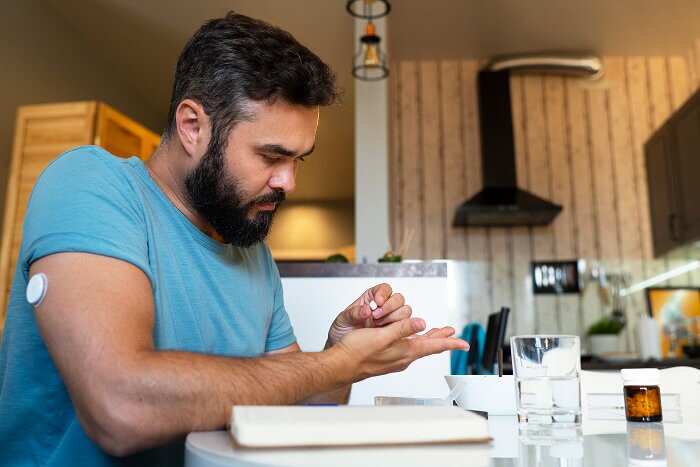
For a long time, continuous glucose monitors were understood to be devices for people with Type 1 diabetes, or for people with Type 2 who take insulin. That logic held up fine. If you’re injecting insulin several times a day, the difference between a glucose of 75 and 275 changes what you do in the next ten minutes.
But what about someone with Type 2 diabetes on metformin, a GLP-1, or an SGLT2 inhibitor, who doesn’t touch insulin? Why would that person need a glucose reading every five minutes when there’s no dose to adjust?
The answer that’s emerging from the research is more interesting than it first sounds: seeing your glucose in real time appears to change what you do — and those changes show up in your numbers.
Research on continuous glucose monitoring in non-insulin-treated Type 2 diabetes has moved quickly over the past few years, and in 2026 it got harder to wave off. The American Diabetes Association’s 2026 Standards of Care now recommend CGM not only for people on insulin, but for people using non-insulin medications that can cause hypoglycemia, and for other treatment situations where CGM meaningfully helps management.
Around the same time, a large U.S. randomized trial in people with poorly controlled Type 2 diabetes who weren’t taking insulin reported substantial improvements in both A1C and time in range.
So should every person with Type 2 diabetes strap on a sensor? Probably not. But the group who’d benefit is considerably larger than the one we’ve been offering it to.
What a continuous glucose monitor actually does
A CGM is a small wearable that measures glucose continuously, day and night. Instead of one or two finger sticks, you get hundreds of readings.
Depending on the device, you can see your current glucose, whether it’s rising or falling, how fast it’s moving, what happens after meals, what happens during exercise, what happens overnight, and how much of the day you spend in your target range.
Most CGMs use a small sensor sitting just under the skin. Worth knowing: it measures glucose in interstitial fluid, not directly in blood. That’s why CGM readings can lag behind actual blood glucose when levels are moving fast, and it’s why the ADA still recommends keeping access to a traditional meter for confirmation when something looks off.
What finger sticks can’t give you, though, is context. And context turns out to be exactly what’s missing for people managing Type 2 diabetes without insulin.
A1C gives you the score. It doesn’t give you the replay.
Almost everyone with Type 2 diabetes knows their A1C. It estimates average glucose exposure over roughly the previous two to three months, and for many nonpregnant adults an A1C under 7% is a common target — though targets should always be individualized.
It’s a genuinely useful test with one real blind spot.
Think of a report card that says your average grade this semester was 78%. True, and not especially actionable. It doesn’t tell you which exams you failed, which ones you aced, whether you’re improving, or whether you fall apart in one particular subject.
A1C has the same problem. Two people can post identical A1C values with completely different underlying patterns. One person sits near 150 mg/dL most of the day. The other spikes to 280 after every meal and drops to 70 a few hours later. Similar averages. Not remotely similar physiology — and not the same risk.
A CGM shows the replay.
What “time in range” means
The most useful thing CGM gives you that A1C can’t is time in range, or TIR.
For most adults with diabetes, the standard target range is 70 to 180 mg/dL. Rather than asking only what your average glucose is, TIR asks what percentage of your day you actually spend inside that window.
For many nonpregnant adults using CGM, the ADA recommends aiming for more than 70% time in range, with goals adjusted for age, other health conditions, and hypoglycemia risk. Seventy percent works out to about 17 of every 24 hours.
CGM also reports time above range, time below range, average glucose, glucose variability, post-meal patterns, and overnight trends. Plenty of that is invisible in the three-month gap between A1C draws.
The CONNECT trial moved the conversation
The most important recent study here is the CONNECT randomized controlled trial.
Researchers recruited adults with Type 2 diabetes from primary-care practices across the United States. Participants weren’t using insulin and had an A1C of at least 7.5%, with an average starting A1C around 8.8%. They were randomly assigned to either use a Dexcom G7 CGM or receive routine care.
That primary-care setting matters more than it might seem. This wasn’t a hand-picked group being managed at a specialty diabetes center — it’s the environment where most Americans with Type 2 diabetes actually get their care, which makes the results far more transferable.
The results presented at the ADA’s 2026 Scientific Sessions:
- After 26 weeks, the CGM group averaged a 6 percentage-point drop in A1C, versus a smaller reduction with routine care — a between-group difference of roughly 0.9 points.
- Time in range finished at about 62% in the CGM group versus 41% in the control group. That’s roughly five additional hours per day in the target range.
- Among participants who started above an A1C of 10%, the average reduction in the CGM group was about 1 percentage points.
Those aren’t rounding errors. A 0.9-point between-group difference is competitive with adding a medication.
But why would it help if you’re not adjusting insulin?
This is the part worth sitting with, because the mechanism isn’t obvious.
Someone with Type 1 diabetes watching their glucose climb can correct with insulin. Someone taking metformin twice a day can’t look at a sensor reading and decide to take more metformin. So where does the improvement come from?
The most likely explanation is behavioral feedback.
A CGM turns diabetes from an abstract lab value into something you can watch happen. Instead of being told that carbohydrates raise your blood sugar, you eat a specific breakfast and watch your glucose go from 115 to 240. The next morning you change one thing about that breakfast and the peak stops at 155.
That’s hard to un-see. It creates a fast loop: food → glucose response → change → new response. Compare that with the standard loop, which runs on a three-month cycle and delivers a single number with no explanation attached.
Investigators involved with CONNECT suggested much of the improvement came from behavior change rather than from adding medication. In a primary-care setting, that may be the most valuable thing CGM does.
It also shows that “healthy” foods hit people differently
One of the first things people notice wearing a sensor is that food doesn’t behave the way the pamphlet says it will.
Take a breakfast of oatmeal, a banana, and orange juice. Every item on that list belongs in a healthy diet. But depending on portion size, preparation, fiber content, medications, and how insulin resistant you are, that combination can produce a serious post-meal spike in one person and barely register in another.
A CGM lets you run small experiments on yourself:
- What happens if you add protein to breakfast?
- What if you halve the rice?
- Whole fruit instead of juice?
- Vegetables before the carbohydrates?
- A 15-minute walk after dinner?
- Dessert right after the meal instead of two hours later?
Instead of waiting three months for the next A1C, the answer arrives in about ninety minutes. That makes diabetes education specific to you rather than generic — and it’s where working with a dietitian pays off, because someone trained in continuous glucose monitoring patterns can spot what’s driving your particular spikes faster than trial and error will.
Why “you should exercise” suddenly makes sense
Every patient with Type 2 diabetes has been told some version of you need to exercise more. Correct, and almost uselessly vague.
A CGM makes the payoff visible. You eat dinner. Glucose climbs. You take a 20-minute walk. You watch the curve bend.
At that point exercise stops being a thing your doctor said would help your cardiovascular risk over the next two decades and becomes a thing you can see working tonight. That’s a fundamentally different motivational proposition, and it’s probably why the behavior changes stick.
What the wider evidence shows
CONNECT is the headline, but it isn’t alone.
A systematic review and meta-analysis published before CONNECT looked at six randomized trials covering 407 people with non-insulin-treated Type 2 diabetes. Compared with traditional finger-stick monitoring, CGM was associated with roughly a 0.31% greater A1C reduction, more time in range, less time above 180 mg/dL, improved glucose variability, and greater treatment satisfaction.
A newer 2025 review covered eight randomized trials and 541 participants in the same population, finding an average A1C reduction of about 0.37 percentage points, an almost 9 percentage-point improvement in time in range, and less time above target.
A 2026 systematic review looking specifically at Type 2 diabetes management in primary care reached the same conclusion.
Notice the pattern: the meta-analyses show modest effects, and CONNECT shows a large one. That’s not a contradiction. CONNECT enrolled people with an average A1C of 8.8% — when control is poor, there’s far more room to move. The honest summary is that CGM helps, and it helps most when your numbers are furthest from goal.
Who benefits most?
CGM doesn’t need to become standard equipment for everyone with Type 2 diabetes. A few groups stand out.
1. People whose A1C is above goal
If your A1C stays elevated despite treatment, CGM answers the question a lab draw can’t: when is the glucose actually high? Overnight? After breakfast? After dinner specifically? More or less continuously? Only after certain meals?
That single piece of information often determines whether the next move should be nutrition, medication, activity, or adherence — and it’s the difference between a targeted change and a guess.
2. People on medications that can cause lows
Some non-insulin medications still cause hypoglycemia. Sulfonylureas are the common example. CGM catches lows that would otherwise go unnoticed, particularly overnight ones that happen while you’re asleep.
This is precisely why the 2026 ADA Standards specifically recommend CGM for people on non-insulin therapies that can cause hypoglycemia.
3. People trying to understand their own diet
For a lot of patients, two to four weeks of CGM functions like an intensive, personalized nutrition course. Rather than a generic handout of foods to avoid, you get your own glucose response to your own meals. It’s especially useful shortly after diagnosis, or during a significant dietary change.
4. People with large glucose swings
A1C hides variability. Someone bouncing between 70 and 250 can produce an average that looks unremarkable on paper. CGM exposes the swings, which matter clinically in their own right.
5. People starting or changing medication
CGM can show what actually happened after a new medication was introduced — metformin, a GLP-1 receptor agonist, tirzepatide, an SGLT2 inhibitor, a sulfonylurea. It doesn’t replace lab work, but it fills in the ten weeks between office visits with something other than guesswork.
What about people on GLP-1 medications?
This is worth its own section, because semaglutide and tirzepatide are now everywhere in Type 2 diabetes care.
CONNECT included a lot of these patients: roughly 40% were on an incretin-based medication such as a GLP-1 receptor agonist or GLP-1/GIP therapy, and 37% were on an SGLT2 inhibitor.
The benefits looked additive. According to the results presented in 2026, participants on a GLP-1-based medication plus CGM saw a larger A1C reduction than comparable participants on GLP-1 therapy alone.
That points at something useful. The medication reduces appetite and improves glucose regulation. The CGM shows you how your remaining food choices, portions, and activity affect what’s left. They’re solving different parts of the same problem, and neither one substitutes for the other.
Do you have to wear it forever?
No — and for non-insulin patients this might be the most practical model of all.
Intermittent CGM use means wearing a sensor for two weeks or a month to understand your meal responses, overnight glucose, exercise effects, medication response, and variability. Then you stop, make changes based on what you learned, and repeat periodically.
The ADA explicitly states that when continuous use isn’t feasible, periodic personal or professional CGM can be considered to help adjust medications and lifestyle.
You don’t necessarily need a sensor on your arm 365 days a year to get most of the value out of the data.
Can CGM replace A1C testing?
No. It adds to it.
A1C remains the standardized measure used to monitor diabetes over time. CGM supplies complementary information: time in range, time above and below range, average glucose, variability, and the glucose management indicator, or GMI.
GMI estimates what your A1C might look like based on sensor data — but it isn’t always identical to a laboratory A1C, and the two can diverge. Both are worth having, and neither one makes the other redundant.
CGM shouldn’t be used to diagnose diabetes
An important boundary, because it comes up more and more: a continuous glucose monitor is not currently recommended as the primary test for diagnosing diabetes or prediabetes. The 2026 ADA Standards state that there’s insufficient evidence for that use.
Diagnosis still runs on established testing — hemoglobin A1C, fasting plasma glucose, oral glucose tolerance testing, or random plasma glucose in appropriate symptomatic situations.
CGM is a management tool. It isn’t a substitute for validated diagnostic testing, no matter what the sensor’s app says.
The downsides
They’re real, and worth knowing before you ask for one.
Cost and coverage. This is the biggest barrier by far. Medicare currently covers CGM for eligible people with diabetes who either take insulin or have a documented history of problematic hypoglycemia. Which means someone with Type 2 diabetes, not on insulin, without a hypoglycemia history may not meet Medicare’s criteria — even when their physician thinks it would clearly help. Commercial insurance rules vary widely. As the evidence accumulates, coverage may well shift, but right now the guidelines and the coverage policies aren’t fully aligned.
Information overload. Some people thrive on the data. Others start watching every fluctuation and get anxious. Glucose is supposed to rise after you eat. A perfectly flat line isn’t a goal of human physiology, and chasing one is a good way to make yourself miserable. The point is spotting meaningful patterns, not reacting to every bump.
Skin irritation. Some people react to the sensor or the adhesive. Often manageable by switching products, changing application technique, or using a barrier.
Inaccurate readings. Sensors occasionally disagree with how you feel or with a finger stick. Lying on a sensor overnight can produce a falsely low reading — a “compression low.” If a reading doesn’t match your symptoms, confirm with a meter before acting on it.
What about healthy people wearing CGMs?
Different question, different evidence.
There’s a lot of interest in glucose monitoring among people who don’t have diabetes, marketed for metabolic optimization, weight loss, longevity, or personalized nutrition. It looks superficially like what we’ve been discussing. It isn’t.
A person with Type 2 diabetes has abnormal glucose regulation by definition. Identifying hyperglycemia and improving control has a clear therapeutic target. For someone with normal glucose metabolism, it’s much less clear that flattening every post-meal rise produces any long-term health benefit at all.
CGM data on a healthy person is interesting. Interesting is not the same as medically necessary.
So — should you use one if you don’t take insulin?
For a lot of patients, it’s now reasonable to consider. The old rule that CGM is only for people injecting insulin is out of date.
The 2026 ADA Standards broadened the recommendation to include people on insulin, people using non-insulin medications that can cause hypoglycemia, and other situations where CGM meaningfully assists management. Randomized trials and meta-analyses consistently show that people with Type 2 diabetes not using insulin can improve their A1C, time in range, time spent high, understanding of their own food responses, and treatment satisfaction. CONNECT extends that into ordinary U.S. primary-care practices.
None of which means everyone should wear one indefinitely. The most useful framing is CGM as an educational and therapeutic tool. For some patients, continuous long-term monitoring is right. For plenty of others, a few weeks of data is enough to find the patterns worth changing.
So the question probably shouldn’t be “do you take insulin?”
It should be: would seeing your glucose patterns help you manage this better? For a lot of people with Type 2 diabetes, the answer is now yes.
Talking it through
If your A1C has been sitting above goal and nobody has been able to tell you why — or you’re on a sulfonylurea and wondering whether you’re dropping low overnight — a CGM may answer questions your lab work can’t. The other half of that conversation is coverage, which is where most of these plans stall.
RescueMD handles diabetes management as part of adult primary care in Allen, TX, including medication selection, CGM interpretation, and dietitian support, in person and by telehealth. If you’re looking for a diabetes doctor and aren’t sure whether a monitor makes sense for your situation, that’s a reasonable thing to bring to a visit.
Frequently Asked Questions About CGM and Type 2 Diabetes
Can you use a CGM if you have Type 2 diabetes and don’t take insulin?
Yes. The 2026 ADA Standards recommend CGM when it can meaningfully assist diabetes management, including for people taking non-insulin medications that can cause hypoglycemia.
Does CGM lower A1C in people who don’t take insulin?
Clinical trials suggest it can. Meta-analyses of randomized trials have found modest but significant A1C improvements in non-insulin-treated Type 2 diabetes, and the 2026 CONNECT trial reported substantially larger improvements among participants whose diabetes was poorly controlled to begin with.
What is a good time in range for Type 2 diabetes?
For many nonpregnant adults using CGM, the ADA recommends spending more than 70% of the day between 70 and 180 mg/dL. Goals should be individualized for older adults, people with significant medical conditions, and anyone at high risk of hypoglycemia.
Is a CGM better than checking blood sugar with a finger stick?
CGM shows far more about your patterns because it measures continuously. Finger-stick monitoring is still useful and still needed when a CGM reading looks inaccurate or needs confirming.
Does Medicare pay for CGM if you don’t take insulin?
Sometimes. Medicare currently covers CGM for eligible patients with diabetes who use insulin or have a documented history of problematic hypoglycemia. A non-insulin-treated patient without qualifying hypoglycemia may not meet the current criteria.
Can a CGM tell me which foods raise my blood sugar?
Yes — that’s one of its main advantages. Watching glucose after meals identifies the specific foods, portions, and combinations that produce large excursions for you.
Can I use a CGM while taking metformin?
Yes. Metformin doesn’t prevent CGM use. Whether it’s medically useful or covered depends on your control, treatment goals, and insurance.
Can I use a CGM while taking Ozempic, Wegovy, Mounjaro, or Zepbound?
Yes, when clinically appropriate. In Type 2 diabetes, CGM can help track how medication, diet, activity, and weight changes affect your glucose patterns.
Do I have to wear a CGM permanently?
No. Some people benefit from continuous long-term use; others do well wearing a sensor intermittently to identify patterns and check the effect of changes. The ADA recognizes periodic personal or professional CGM as an option when continuous use isn’t feasible.
Can CGM diagnose diabetes?
No. Current ADA guidance states there’s insufficient evidence to use CGM to diagnose diabetes or prediabetes. Standard laboratory testing should still be used.
Should everyone with Type 2 diabetes get a CGM?
Not necessarily. CGM is most valuable when the information is likely to change treatment or behavior. Someone with stable, well-controlled Type 2 diabetes will gain less than a person with an elevated A1C, significant variability, hypoglycemia risk, or real uncertainty about how food and activity affect their glucose.
Medical Disclaimer:
This article is for educational purposes only and does not replace individualized medical advice. Diabetes treatment goals and glucose-monitoring strategies should be individualized based on medications, medical history, age, risk of hypoglycemia, cardiovascular and kidney disease, and other health factors. Discuss the use of a continuous glucose monitor with a qualified healthcare professional.